Friday, February 7, 2014

Final post from New Zealand

The time has finally come...

We are all but packed up (the packers come on Tuesday to pack up and remove everything that is moving to the US), and sorted ready for the move.  It's been a while since I posted anyting - driven mainly by the lack of fiber work undertaken, but here is a brief summary:

I missed the November guild meeting, as I was in North America briefly (including a little bit of house hunting in TN) - Anne did go along though.  Then we both missed the next meeting as we had visitors over from the US, which left the final meeting this month (Feb - there isn't a January meeting) - so time to return our library books, and say some good-byes to the wonderful group of weavers we got to know in our year back here.

I gave my 6 year old granddaugther a drop spindle (an Ashford top whorl beginners spindle) and wool to start her off (young) with an interest in fiber, although she was far more interested in my mandolin - also given to her for future use.

My sister-in-law gave me the Ashford traditional (1 of 4 wheels she had!) that I had had on loan all year.  I have spun quite a lot of fiber on it (also from Jenny) and really did enjoy it - so was very pleased that it will now join my Rappard 'Little Peggy' in the US. (2 out of 2 NZ wheels!).

The upright loom was dismantled and moved to the garage to join the counterbalance loom (parts) ready to be uplifted by the packers.
The two looms in pieces ready to be packed
 All going well we should be established in Eastern Tennessee by mid-summer, and hopefully I can get all my looms up and running in one place.

Tuesday, September 24, 2013

Back to Spinning

It's been a few weeks since I had the spinning wheel out - it was put away when we were tidying up ready for visitors, and then most of the craft work after that was weaving (the tartan and the Navajo throw/rug).

I found some very nice camel roving in the stash that my sister-in-law was kind enough to include with the spinning wheel I have on loan.  It's a beautiful light brown/fawn colour and very very soft.  Initially I thought it was angora, but the bag clearly has camel hair 1lb, $2.50 (I suspect it was purchased quite some time ago).  There is about half of that 1lb left, so I'll make up some 2-ply with it, and then use some white angora to make up enough for a scarf of some kind.

First of the camel
The roving spins very easily, although not with my normal Clun Forest short forward draw.  With that method it tends to 'grab' very quickly and can without much warning end up with a super thick portion with the only solution to remove it and join a new section.  I was able to spin some fairly smooth medium thin yarn, but really had to pay attention to the spinning.  By using a modified draw - drawing the drafting hand back like a long backward draw and controlling the spin with the forward hand a lot more the yarn became a little more manageable.  It was interesting to see the 'cut/shorn(?) ends looping around the drafting triangle as the yarn was twisted and drawn out.  Twisting in themselves at a slightly different rate.  Not sure what causes that, but it doesn't do any harm.

I nearly finished enough for two bobbins last night so should be able to finish this in a few nights.

In the meantime the Navajo inspired rug/throw is going very well.  I'm able to weave about an inch an hour (there are 5 shuttles, and the blue colour changes in a Fibonacci sequence on every direction change.  Anne suggested a name for it so it will now be known as the Turquoise Lightning blanket (it is the light coloured blue that inspired the name)

Progress on the blanket

Monday, September 16, 2013

Family Tartan

With a busy Sunday of weaving I managed to finish off the tartan sampler that began so long ago.  It only took two days of weaving to make up the 15 inch sample once everything was prepared.

The skeins wound onto balls prior to warping
 The warping took a lot of knotting - changing the colours at each of the many stripes.  Each colour having a minimum of 2 threads so the knots were all at the one end.

The warp tied on to remaining warp.
To cut down the amount of the hand spun/dyed yarn that would be wasted the warp was tied on to the remaining warp after the ikat project, plus enough to make up the number of ends.  The 200+ weavers knots meant that by the end I was fairly quick at tyeing them! 
Tartan on the loom
 The weaving was fairly quick and once I worked out the right beat to maintain the 45 degree twill line, it was relatively easy.  With the weft threads having a minimum two for each colour all the shuttles stayed on one side and I was able to hook them into the selvedge on the way up the right side.
The traditional wine at the finish of the weaving

Tartan off the loom and sewn at either end

Simulating the cushion that it will become.
The next job will be to full the cloth and then to sew it into a cushion to put on the couch.  In the mean time it is back to work on the large loom and the Navajo throw/rug.

Progress on the zig-zag throw/rug.

Monday, September 9, 2013

Ikat finished

Anne took over the weaving of the ikat scarf/sampler from me which allowed me to head back upstairs to the upright loom to work on the Navajo throw/rug (good progress there).  We managed to finish the ikat with almost exactly the amount of weft wool planned.  I dyed the last lot of stripes (measured correctly for the width).  That ran out about half an inch from the second 'chevron' (warp ikat) which allowed us to use plain white for the weft emphasising the white blocks caused by off-setting the warp yarn (white) stripe.  I then dyed some stripes at the shorter weft width as done at the beginning of the weaving just to finish it off. There was about 10 turns on the bobbin when the warp could be wound no further.

As with all 'finishing' we celebrated with a wine - this time both of us as it was really a joint project.

I have to prepare a 'pdf' instruction sheet with photo's to give out to the guild members this coming weekend.  We don't have our normal meeting, but are instead heading to the Port Nicholson guild exhibition in the morning and then heading for lunch out at the gallery.

Warp stripes - with binding to stop the dye spreading.
Weft ikat 'winding' up the warp.
 With the warp width and the weft strip width only slightly off-set the red/yellow/red stripes move alternatively right and left as the weaving progresses.  Obviously wrapping around and moving back when they hit the selvedge.  Only slight variations in warp width can mean larger 'loops' right up to a 'standing stripe'.

Warp ikat 'chevron'
The warp stripe, off-set by the shifting device.  Not particularly tidy, but shows the principle.  The other chevron was less clear as it appeared underneath the weft ikat stripes.  I would try and do something a little more tied together if planning this again.

All finished this project.
  The plyed warp held up well, and the quickly spun Clun Forest two-ply weft matched very nicely.

Friday, August 16, 2013

Guild project

Anne finished her section of the guild cotton project.  The complex twill went pretty well over all.
The finished project.
All at the guild were impressed with Anne's first time efforts.  The rest of the weaving should be finished by the next meeting so we will be cutting off our own sections ready to hem and then wash.  It will be good to see them hanging side by side.

Ikat weaving project

The guild ikat project has moved on after the last meeting.  Our goal was to tie up the resists so that the warp could then be put on the loom.  Everyone had a go, and all seemed to go fairly well.
Attentive (or was the confused) audience

Anne and Jinnie busy wrapping the resists onto the warp

Resists tied - using both rafia and plastic

Resists, after the dyeing

Resists removed.
The dye used was Ashford wool dye - a mix of yellow and red, based on the dry weight of the wool.

Tied on using the shifting board.
 The loom was dressed front to back (a first for me - I usually dress back to front), as this was the simplest given the unique way of offsetting the warp.  Once the reed was sleyed and the heddles threaded the step shifting board was attached to the back beam (bungy cords) and using the 'off-sets' of the steps the warp was tied on.  Once the shifting board was removed and the warp pulled back through from the front the off-sets become obvious.

The off-set blocks of the stripe.
Once wound on to the warp beam the front was tied on and now I only have to wait for the weft yarn dye to take (24 hours) and then dry and I'll be ready to start weaving.
Stripes painted on weft wool.
Using Earth Palette dyes I painted colour stripes on the weft wool (some of it - it will be done in batches).  Nothing precise, but the red and yellow are in approximate positions - marked on the wood.  That was then wrapped and is sitting in the hot water cabinet for 24 hours.  Once rinsed and dry the wool will be put on a bobbin and will form stripes through the length of the scarf, but off-set so should wind from side to side, based on the repeat width.

Tartan Dye

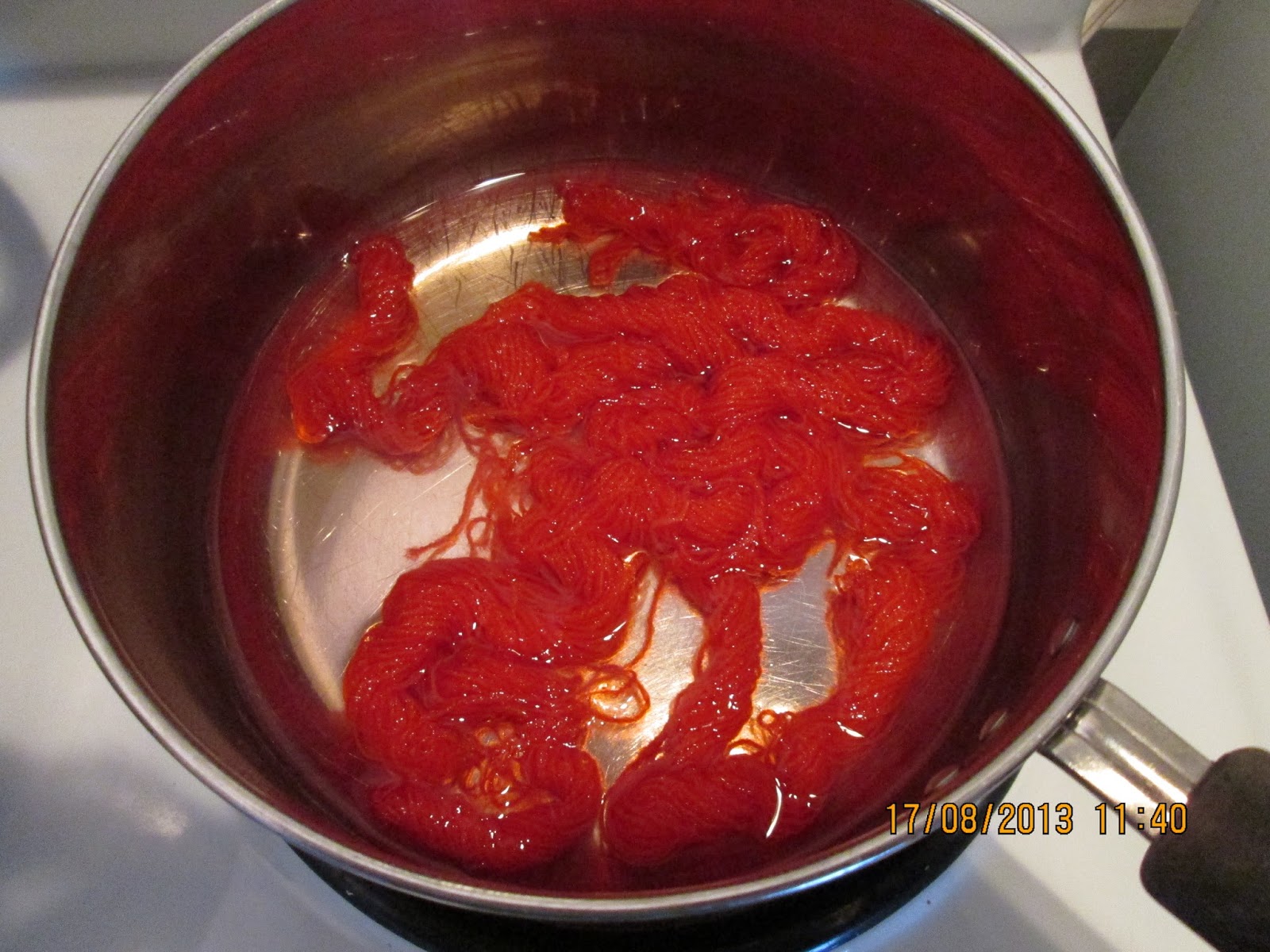
Today being a rainy, cool Saturday - perfect to catch up with some of the tasks.  I had the 3-ply all spun for the tartan sampler, but had not done any dyeing.  I spend this morning dividing up the skeins into the required amounts and then pot dyeing them with Ashford wool dye.
Red dye, coming to the boil

Dye exhausted

The four colours, plus white of the tartan.
The wool now has to dry and then it will be ready to divide (half for warp half for weft - loom waste will be scrap wool).  That will be the next project after the ikat weaving is finished.